In life sciences the basic, functional unit of cooperation and research is a LAB.
Now am I alone with my opinion that most academic laboratory web pages simply do not meet any advanced, current, dynamic web standards, although this would be crucial for them?
What information should a good laboratory homepage offer, and what design would be desirable? What is the proper balance of design and functionality? Considering content: principal investigator and lab members, research interests, publications, available positions, contact infos, grants, methods, setup, tools, cooperative partners, awards, multimedia files, audios, videos, blogs, news, media coverages, interviews? In contrast, many lab pages say that they were last updated in 2004. Unthinkable. I got a one sentence theory on why many academic web pages suck today: scientists (dominantly physicists and mathematicians) were out of the first inhabitants of the word wide web, and most academic web pages were made by scientist-turned web geeks in the 1.0 era. But that era is clearly over, the 90’s has gone, and what we are seeing today is often not enough.
As I am more tempted to immerse in positive criticism, I link here 3 lab homepages in alphabetical order in my beloved stem cell and mitochondria field, which are quite good and I’d like to ask my readers which of them is the best and why? Also, I’d like to start a unofficial competition for the best laboratory web page on the Internets, so please readers, place your bets and suggest your nominees. List of the other nominees can be found at the end of the post.
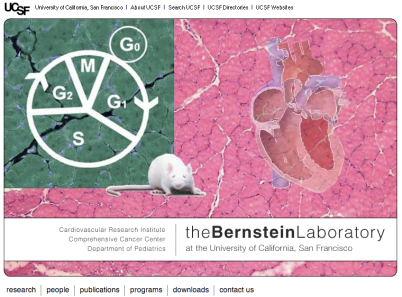
Bernstein lab (look at the video)

Update: Readers also suggested the following ones:
Refinetti lab, University of South Carolina from Coturnix.
Jessell lab of Columbia Univ. from Alvin.
Redfield lab from Dr. Rosemary Redfield.“It’s not slick, but it’s open science. We post our grant proposals as soon as they’re submitted, and the page has links to our blogs about our research-in-progress.”
Gregory lab from Professor Ryan Gregory.
Kissinger’s lab from Nandita Mullapudi. “I like ours because it is fancy-free, clean and slick. It has links to websites that are research based as well as daily-use websites like the university system, etc, making it convenient for a homepage.“
Hui lab from Zachary Moore.
Laboratory of Tree Ring Research from Jim Swetnam, although it is more of a research institute than a distinct laboratory.
Purvis Lab at Imperial College, UK from Dave Hone.
Leander lab, Roger lab, Archibald lab, Waller lab, Patterson lab from Opisthokont.
Ramaswamy lab from Matt.
Rissler lab from Kathryn Perez.
Evans Group from suchire.
Zhang’s Lab of Molecular and Genomic Evolution from TR Gregory.
Stagljar Lab from Eva.
Ruthazer lab from Jeff.
Mullin’s lab from peretz.
Wolpert lab Cambridge University from Ah.
Duffy lab University of Connecticut from John.
Pielak lab at UNC Chapel Hill from Gary Pielak. Simplicity. Also saying where students end up.
John Plane’s lab in Leeds from JD.
Conklin lab from Natalie.
Wilkinson lab from Pierre based on the semantic web and RDF graphs. Not bench science but bioinformatics.
 Deep, healthy lifespan extension
Hi! I got directed here from Cortunix, but here’s a dev bio lab’s webbie. Cheers
http://sklad.cumc.columbia.edu/jessell/
Thanks Alvin, post updated.
Check out ours (www.zoology.ubc.ca/~redfield).
It’s not slick, but it’s open science. We post our grant proposals as soon as they’re submitted, and the page has links to our blogs about our research-in-progress.
The University of Texas’ Southwestern Medical Center department of Molecular Genetics page is pretty good.
As is this lab page in the University of Cincinnati’s department of Pathology and Molecular Medicine, if I do say so myself.
Thank you very much for the nominees, I try to keep them updated. Please also tell us why do you think these pages are good and functional and what special features they have. Zach: The University of Texas’ Southwestern Medical Center department of Molecular Genetics is not a lab.
http://www.ltrr.arizona.edu
I would like to nominate the web page of the Laboratory of Tree Ring Research at the University of Arizona. See the link above
The ‘Purvis Lab’ at Imperial College, London UK, has an excellent homepage. Lots of papaers, recent works, CVs, links and the rest.
http://www.bio.ic.ac.uk/evolve/
I’m always a little weirded out when I come to a laboratories homepage that’s completely tricked out. It just seems like it would be a better use of time/money to be doing research. Just give me the basics so I can find what I need.
Here are a few good laboratory homepages from my field of research:
http://www.botany.ubc.ca/bleander/home.html
http://rogerlab.biochemistryandmolecularbiology.dal.ca/
http://myweb.dal.ca/jmarchib/
http://www.botany.unimelb.edu.au/eukdiv/
http://www.bio.usyd.edu.au/Protsvil/
Good enough, perhaps?
Perfect little collection Opisthokont, thanks. A commenter at Pharyngula called the problem discussed here “out-of-date webpage syndrome”.
http://sil.biochem.uiowa.edu/
This is my favorite: Dr. Leslie Rissler at University of Alabama.
http://bama.ua.edu/%7Erissler/
http://daecr1.harvard.edu/ is definitely one of the top for chemistry.
A nice page at http://www.umich.edu/~zhanglab/
I really like this one:
http://biochemistry.utoronto.ca/stagljar/index.html
It’s a lab in my department, but not my lab. Our own lab website is confined by hospital regulations that even prescribe which font to use, where the words go, and which words should or shouldn’t be bold. No room for creativity…
Very interesting. I’ve posted about this on Nautilus at:
http://blogs.nature.com/nautilus/2007/04/what_a_good_laboratory_home_pa.html
Look forward to finding out who wins!
All best
Maxine.
http://www.biodesign.org
The only reason why most research websites suck is because most academics don’t know HTML, or the importance of HTML.
Here’s a cool one, not the best, but fun…
http://ruthazerlab.mcgill.ca/
I like this quirky one from the Dyche Mullin’s lab at UCSF:
http://mullinslab.ucsf.edu/
I recently discovered this one which I like – it has a blog and everything:
http://brembs.net/
http://bjoern.brembs.net/news.php
Can I nominate Tulane Gene Therapy for “worst offender”?
I saw a mention of your name at NFTB and I thought it sounded familiar. You visited our lab back in March. How’s it been going?
Hi Grady, thanks I ‘m fine, how about you? Well here we are seeking good laboratory web pages in the ocean of not too good lab pages so I do not think that seeking “worst offenders” is the best idea. Actually I was really amazed by the Virtual Tour of the Center for Gene Therapy at the Tulane site since it is informative, full of multimedia (nice motion pictures) and…personal. So virtual tours around labs are cool features.
This is a cute competition….
The best site by far that I have seen is of Dale Purves’ lab. It is esthetically presented, has all of the key information a surfer needs, is updated all of the time, and has a really good see for yourself section, which is a lot of fun.
The adress is: http://www.purveslab.net/main/
I like to keep my site simple; my brother Chris designs it. I also believe in saying where students end up.
John Plane’s Group in Leeds: Something plain and simple and in keeping with the university website rules!
http://www.chem.leeds.ac.uk/JMCP/
Can anyone recommend an easy-to-use system for maintaining academic web sites? Some sort of template for a content-management system, for example? Ideally free software? Something that can be hosted on a lab computer and that has a non-HTML-interface for non-technies to update things easily?
Mark Wilkinsson’s lab
http://bioinfo.icapture.ubc.ca/
it may looks austere but it is based on semantic web. A RDF graph (http://bioinfo.icapture.ubc.ca/labinfo/labinfo) is painted via graphviz , it can be used to quickly navigate to the information you are looking for and this data can be interpreted by a software.
Pierre
Natural Products Synthesis lab at the IPNA-CSIC (and any of its other labs):
Natural Products Synthesis lab
General menu is always present allowing direct access to any web section.
General contact info is always present at the bottom.
From a technical point of view:
– Most of the websites offer a plain e-mail address format instead of a tweaked one probably leading to massive spam attacks.
– CSS-based structure is preferred to tabular one.
– We are currently moving to a custom content manegement system.
Antonio
Harlan, you could check out PublicationsList.org (I helped develop it).
Its not a complete solution for lab websites, but it gives a neat way to handle publications where the collective list is dynamically included in your site but each member just manages their own list on the server.
If your papers show up on PubMed you can also set up an email alert where you just cick to confirm whether a new paper should be added to the list.
Robert
This isn’t terribly fancy, but this part of my lab’s website gives everyone passing through our lab a useful starting checklist on where to find lots of important daily use items. (Yup, I maintain it….)
Biased opinion perhaps, but definitely a fan of my colleagues’ site:
The Columbus Lab at UVA
Vawter Lab at University of California, Irvine
Without doubt your design should dynamic that gives a good first impression, bearing in mind what your customers find interesting, in the same breath the conet needs to be search engine freindly. Acheive this and links into your site will occure naturally asvisitors save to social sites, add to their own websites etc etc read the google webmaster tools for how best to acheive this – a multitude of advice is available.
http://www.biochem.northwestern.edu/morimoto/index.html
is a good website from a huge c. elegans lab. They must have over 100 categorized links to anything related to the lab, including excellent protocols.
This isn’t terribly fancy, but this part of my lab’s website gives everyone passing through
I found this page because a lab website I designed is linked from here, Igor Stagljar’s lab. It gets about 40 hits a day! Which is kind of a lot, especially since most of the links are from Google image search. When you draw a scientist as a Jack Kirby cartoon character for the home page, apparently that gets noticed.
I’m an ex architect turned artist and graphic designer, and when I started designing lab pages back in 2000, there really wasn’t even a single site worldwide that I could find online to show my clients as an example of good design! Not for navigation, overall feeling, content structure – I’m glad to see how much things have improved!
The websites I designed are focused on showing the personality of the lab. As exciting as the science in the labs is, it’s often tedious work and attracting the best people is a priority. Each lab site I design has a strong focus on navigation, content organization, and personable, distinct design. I work with my cartoonist boyfriend to come up with original logos and illustrations to make lab sites unforgettable. And cool!
You can see my website design page here: http://www.rna.ca/websites.
Some additional labs of note:
It all started with the U of T Biochemistry Department. The website is starting to get a little bit scrambled now, after 9 years of amendments by department members at large, but still holds a distinct look and the robust navigation system keeps people from getting lost on the large site.
Grant Brown Laboratory was the first lab website of its kind that I designed.
Charlie Boone’s Lab wanted “groovy” and “orange”, and that’s exactly what they got. Note the army of pipettes in the backgrounds, and don’t miss the People page mouseovers.
Dr. Durocher was more specific: “old school geek”. Yessir, we do that!
Sherbet colours meet scientifically correct illustrations in Bishop Lab at McMaster University, Hamilton.
And Sidhu Lab simply shines with a jewel coloured abstract background and a simple, sophisticated colour scheme for the text. Again, mouseovers on the People portraits were met with delight!
This is a new website that I liked. It is a Molecular Epidemiology Lab and has some real nice info.
I also like it coz it is very easy to follow and is well organized.
I would rank this website high on my list.
Adult webmasters Are able to use a new site to get ahead. VW Entertainment has come out kicking on to the marked with a crazy new affiliate program. Being able to promote multiple sites in a network using I-Frames, Banners, or text links and a great conversion is what its all about and they have it!! for any other questions about them find out more
электронная почта без регистрации
This list is great, but although it highlights some good examples, it still leaves me a little bit in the dark on the best way to create a lab website. Ideally I want to find an integrated blog/wiki theme (for free) within WordPress so everyone can update the site with ease. The main site would be wiki based but one of the pages would be blog/news. I can do wiki, and I can do blog, but finding a way to link these two has got me puzzled. Any thoughts?
What does a good laboratory homepage look like? Show me at least one! Its A nice topic on Web And Information Are Importand In This blog i Became Your Fan An Tryn’ To Write A Blog On Cancer Topic plz Suggest Me Some Topic For Blog http://curefromcancer.blogspot.com
Home
Try this analytical testing lab…
great blog i love this blog good blog nice info Make Us Healthy
It seems I must bookmark your blog for further formation and keep coming back for such good posts. Thanks for the Lab lists.
This help me a lot for my research. I’ve been doing great for your blog. Cheers!
How amazed I am when I coming back to your blog everytime. It seems you always give away some good info. Thanks for all of your good works.
To be honest, Bernstein lab is the coolest one for me.
Wow… This homepage is very nice. It’s gonna be help me for my work. Thanks!!!
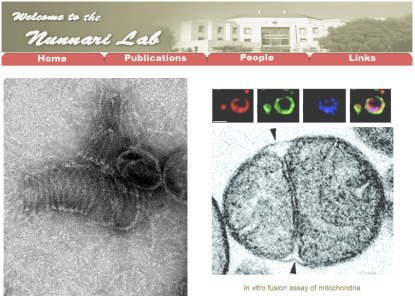
I go for Nunnari lab as your laboratory homepage.
Thank you kurb
Thanks for the nominees, I try to keep them updated. Also tell us why do you think these pages are good and functional and what special features they have.
This article is help me so much about my research. I’ve been doing great for your blog. Cheers!
I’ll give my vote to the Bernstein Lab.